Resistors have two different diagrams and ways of being shown on a schematic. The first (and more common) is the North American way:

the 2nd is the European way:

In these labs, we will be sticking to the North American symbol.
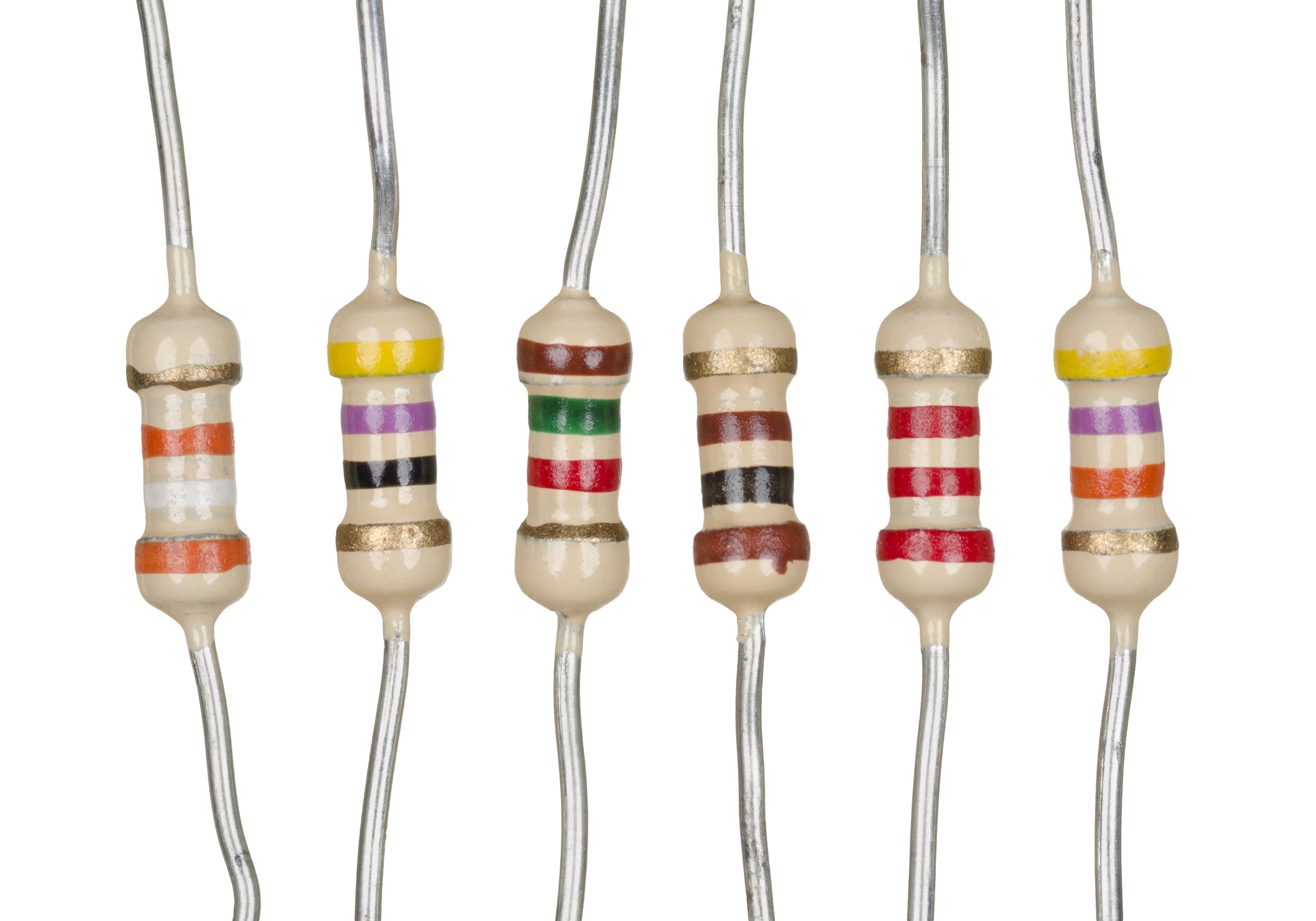
Resistors are small skinny devices with two legs and coloured stripes. Unlike LEDs, it doesn't matter which way around you place resistors in your circuits. To make them look a little better, try to have all the gold stripes facing the same way.
The purpose of a resistor is to restrict the flow of electricity though a component such as an LED, or switch. As different components need different amounts of electricity to function it is important that the correct size of resistor is selected for the job.
The size of a resistor is measured in Ohms, and is given the symbol Ω. It is a common practice to show resistors above 1000Ω on a schematic as 1kΩ. As a result, you should never see a 4700Ω resistor in a schematic, but you'll find plenty of 4.7kΩ. Once you get above 1000kΩ, or 100,000Ω, it'll be written as 1MΩ (but you don't need to worry about that in these labs).
Because different sized resistors restrict more or less electricity you can use them to control the brightness of your LEDs.
If you notice that one of your LEDs is too bright, you can remove the resistor powering it and replace with a different resistor with a higher resistance.
Vise-vera, if the LED isn't bright enough, you can replace the resistor with one that is smaller, now it should be brighter.
You've probably already noticed that the size isn't written on the resistor. Instead, a series of coloured stripes, refered to as "bands", indicate what the size of the resistor is. Refer to the chart below to correctly identify resistors.
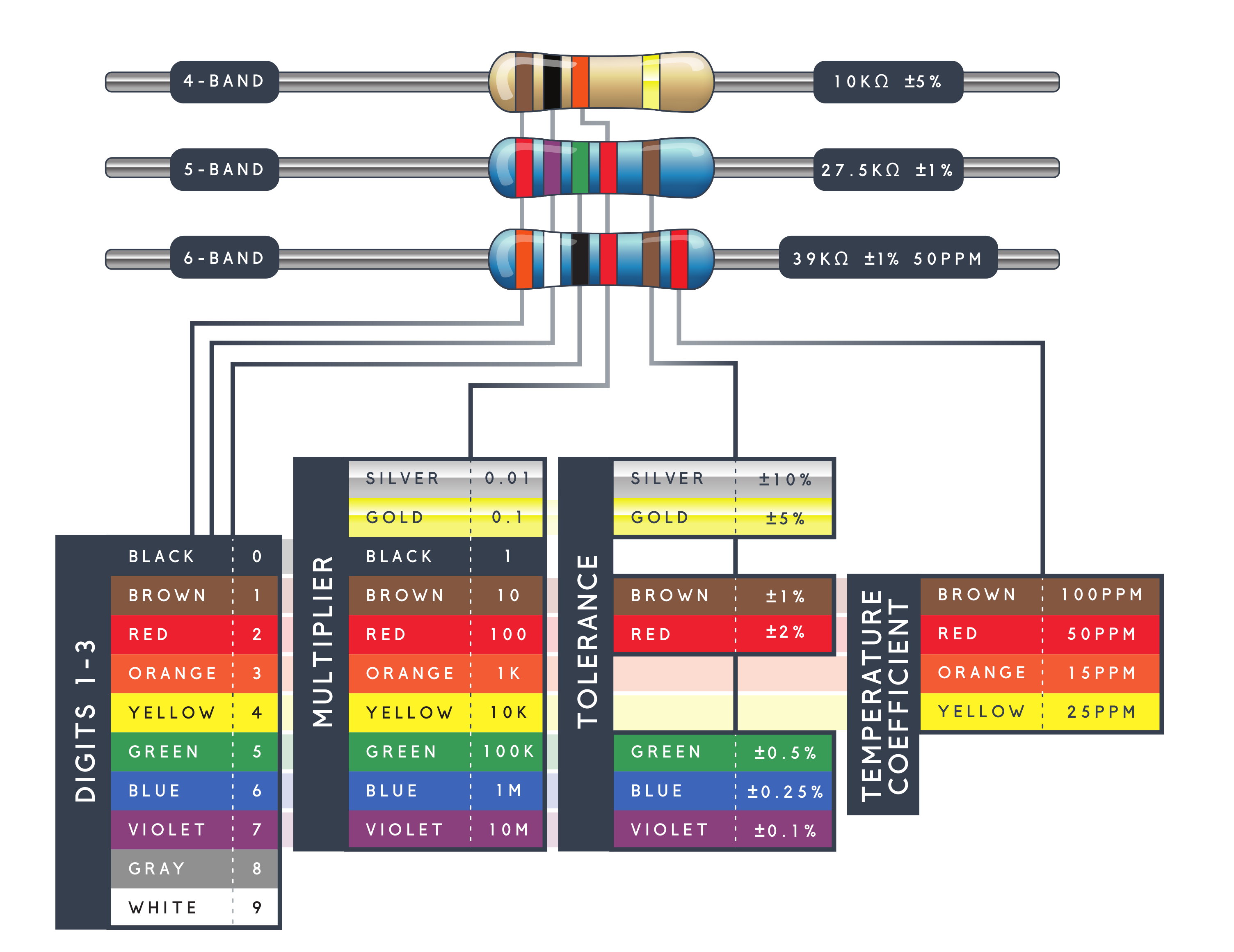
In our lab, we exclusivly use 4-band resistors. The 1st band is the 1st digit of the code. (You can orient the resistor to find the 1st band because it is never the gold one!) The 2nd band is the 2nd digit of the code. The 3rd band is the multiplier. Take the first two digits and multiply them by this number to get the actual value. The last band is the tolerance, because it is always gold it is always ∓5%.
For example, if a resistor is Yellow (4), Violet (7), Red (100), Gold (∓5%), then it is 47*100=4.7kΩ.
You can also use tools like All About Circuits' resistor calculator to find the resistance of LEDs without worrying about misreading the table.
 : allaboutcircuits.com - Resistors and Ohm's Law